


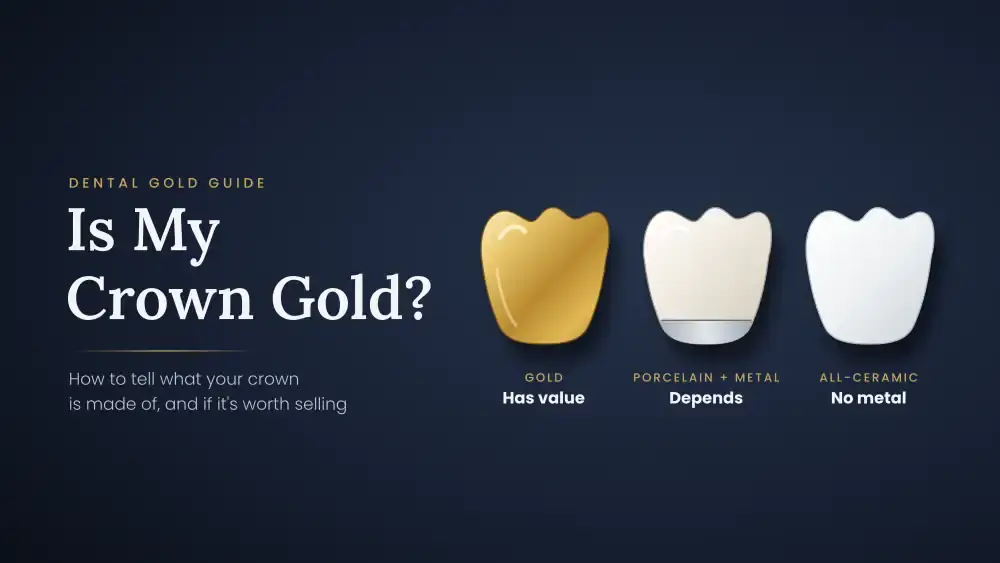
Is My Crown Gold? How to Tell What Your Dental Crown Is Made Of
Your dentist replaced an old crown and handed it back to you in a little bag. Or you found one in a drawer years later. The first question is simple: is it gold?
Not every crown is. Many crowns made today have no precious metal at all. Others have a layer of metal hidden under the porcelain. Here's how to tell what your crown is made of, and which ones are worth bringing in.

The Short Answer
Crown type | What it looks like | Precious metal? |
Full gold crown | Yellow or gold-colored metal all over | Yes, usually high in gold |
White metal crown | Silver or gray metal all over | Maybe. It can be a palladium alloy or a base metal |
Porcelain-fused-to-metal (PFM) | Tooth-colored outside, with metal inside or at the gumline | Sometimes. It depends on the metal underneath |
All-ceramic or zirconia | Tooth-colored all the way through, no metal | No |
Stainless steel (children's crowns) | Thin, shiny silver shell | No |
1. Look at the Color
A crown that is yellow or gold-colored all over is very likely a gold alloy. These are the crowns most worth selling.
A silver or gray metal crown is harder to judge. Some are made with palladium, which is a precious metal with real value. Others are nickel or cobalt alloys with almost no resale value. You can't tell the two apart by looking. That takes testing.
2. Check the Inside and the Edges
Most tooth-colored crowns from the last few decades are porcelain-fused-to-metal. The porcelain is baked over a thin metal shell. Look inside the crown or along its bottom edge. If you see a band or layer of metal, it's a PFM crown.
A slightly gold tint in that metal layer is a good sign. A dull gray layer may still be palladium or may be base metal. If the crown is the same white material all the way through, it's all-ceramic or zirconia, and there's no metal to recover.
3. Ask Your Dentist or Check Your Insurance Paperwork
This is the most reliable shortcut. Your dentist's records list what the crown was made of. If insurance paid for it, your Explanation of Benefits will show a procedure code that names the metal type.
Code | What it means | Worth selling? |
D2790 | Full cast crown, high noble metal | Yes, best value |
D2792 | Full cast crown, noble metal | Usually |
D2791 | Full cast crown, predominantly base metal | Little to none |
D2750 | Porcelain fused to high noble metal | Yes |
D2752 | Porcelain fused to noble metal | Usually |
D2751 | Porcelain fused to predominantly base metal | Little to none |
D2740 | Porcelain or ceramic crown | No metal |
What High Noble, Noble, and Base Metal Mean
Dental alloys are graded by how much noble metal they contain. Noble metals include gold, platinum, and palladium. Silver doesn't count.
High noble: at least 60% noble metal, with at least 40% gold. This is the most valuable grade.
Noble: at least 25% noble metal. Often high in palladium, which still has value.
Predominantly base: less than 25% noble metal. Usually not worth selling.
What About Fillings, Bridges, and Partials?
Gold fillings, inlays, and onlays: these are often gold alloy and can be sold the same way as crowns.
Silver-colored fillings: these are amalgam, which is mostly mercury, silver, tin, and copper. They are not gold.
Bridges: the same rules as crowns apply. A gold bridge has more metal than a single crown, so it's usually worth more.
Partial denture frames: these are usually cobalt-chromium, a base metal with little resale value.
How Much Is a Gold Crown Worth?
It depends on three things: how much the metal weighs, what the alloy contains, and the day's prices for gold, platinum, and palladium. Porcelain and any tooth material attached don't count toward the value. Only the precious metal does.
A single crown is a small piece, so the payout varies a lot from one crown to the next. The only way to get a real number is to have it tested and weighed. Our guide to what dental gold is worth covers how buyers value it.
Tips Before You Sell
Planning to have a crown replaced? Ask your dentist to give you the old one. It's easiest to ask before the procedure.
Don't try to break off the porcelain yourself. A buyer can test the metal with it attached.
Rinse and dry the crown and keep it in a small bag.
Bring all your pieces at once. Several crowns, along with old gold jewelry, add up faster than one item.
The Quick Version
Yellow metal: likely gold. Worth bringing in.
Gray metal: could be palladium or base metal. Needs testing.
Tooth-colored with metal inside: porcelain-fused-to-metal. Value depends on the metal.
Tooth-colored all the way through: ceramic or zirconia. No metal value.
Fastest answer: ask your dentist or check the code on your insurance paperwork.
Get Your Dental Gold Tested
Not sure what your crown is made of? Bring it to our East Hanover or Hamburg location. We'll test and weigh it in front of you and explain what it's worth, with no obligation to sell. Learn more about how we buy dental gold, or get an offer online. Call (973) 428-1900.


